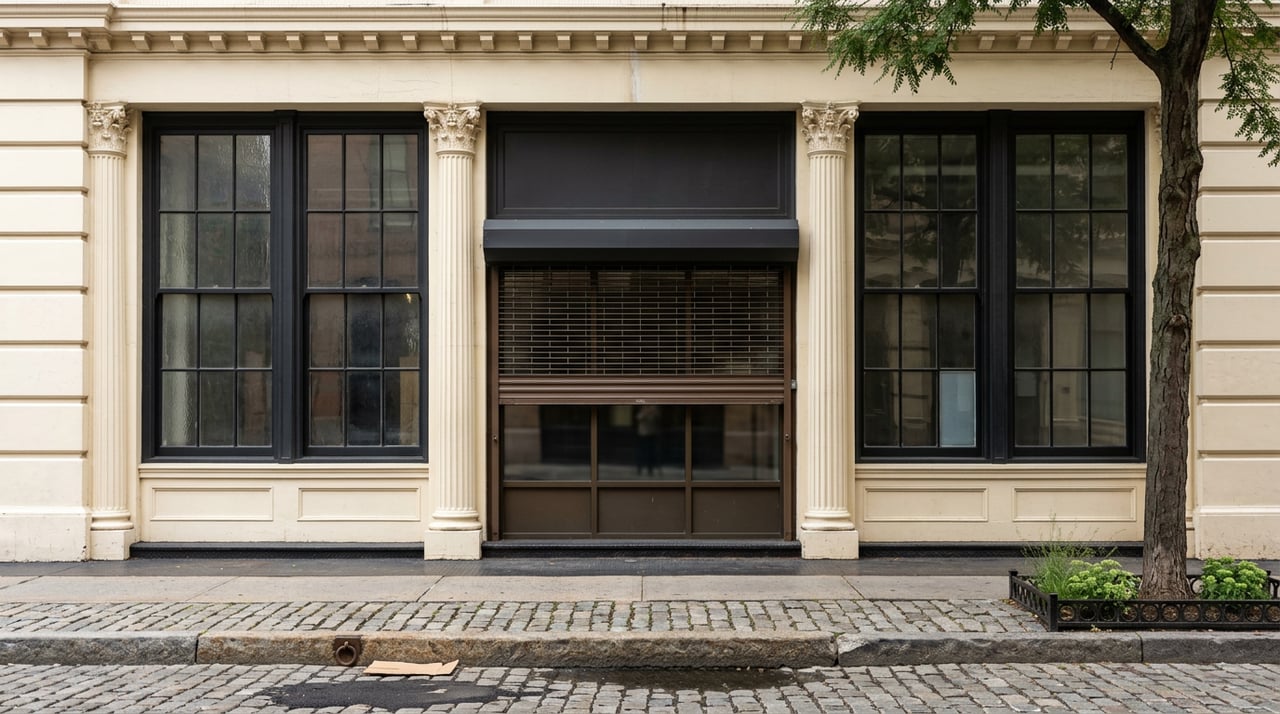
Broadway is not being reconstructed through SoHo as one continuous city project. The change is more distributed, and more revealing. Storefronts are being rebuilt, established brands are moving within the district, large spaces are taking on new uses, and modest improvements are changing how the sidewalk functions.
For anyone asking what's new in SoHo this summer, the useful answer is not a list of openings. It is a change in the corridor’s operating model.
SoHo Broadway has recovered its audience, but it is not returning to an earlier version of itself. The street is shifting from a collection of fixed, decade-long anchors toward a more flexible mix of urban concepts, temporary stores, specialized flagships and rotating experiences. The names may be familiar. Their footprints, formats and positions on the block are being reconsidered in real time.
The numbers describe continuity, not a comeback
The latest figures complicate the usual retail-recovery story.
According to the SoHo Broadway Initiative’s July 2026 report, the district recorded 18.1 million visitors from June 2025 through May 2026. The comparable prior period drew 17.9 million. Storefront occupancy held at 87% in both the first and second quarters of 2026.
That is the baseline for understanding the construction walls and new signage. Broadway is not being remade because the corridor lacks activity. It is being remade while foot traffic and occupancy remain firm.
At the end of 2025, occupancy had reached 89%, the highest level recorded by the SoHo Broadway Initiative since it began tracking the figure in 2018. The slight move to 87% in early 2026 arrived alongside continued openings, relocations and build-outs. Vacancy alone does not explain what is happening.
The more useful reading is that owners and retailers are reassessing what a Broadway address should do. Some brands are committing to larger, more specific presentations. Others are replacing multilevel stores with smaller concepts designed to change frequently. The corridor is active enough to support both approaches.
The 529 Broadway conversion sets the pattern
The clearest example sits at the northwest corner of Broadway and Spring Street.
Nike closed its large store at 529 Broadway on January 10, 2026. IKEA is now building its second Manhattan location in the property, with an opening planned for fall or winter 2026.
IKEA describes the SoHo store as an approximately 25,000-square-foot operation across the first and second floors. Plans include a studio for kitchens, closets and bathrooms, a selection of accessories available to take home, and a Swedish Deli. The upper floors of the roughly 53,000-square-foot building are being renovated for office use.
This is more than one retailer replacing another. Nike used the address as a major sports flagship. IKEA is adapting it into a compact urban format that combines planning services, immediate purchases and food.
Nike, meanwhile, did not abandon the district. On April 16, it opened a temporary Nike and Jordan Brand store at 611 Broadway in the Cable Building, directly across from Adidas. The space has been designed to change with New York’s sporting calendar and has included customization, NikeSKIMS and a Jordan “Soul Tower.”
The move from 529 to 611 Broadway captures the broader shift. A brand can reduce or alter its physical footprint while preserving a SoHo presence. The former flagship becomes a different kind of urban store, while the outgoing tenant reappears several blocks north in a more adaptable setting.
SoHo is retaining the brands, but changing the architecture of how they meet the street.
The middle blocks are becoming more specialized
Between Canal and Spring, the same pattern appears at a finer scale. The corridor is gaining stores with a clearer point of view rather than filling every opening with another version of the same apparel format.
Consider the sequence moving north:
- The Collective SoHo, 435 Broadway: Opened in April with rotating independent vendors offering jewelry, art prints, handmade gifts and vintage pieces.
- Jaded London, 434 Broadway: Opened in March as one of the London-designed brand’s two United States stores.
- Carl Friedrik, 458 Broadway: Brought its luggage, bags and accessories to the corridor in March.
- SKIN1004, 470 Broadway: Opened its New York flagship on May 11 with nature-inspired interiors and products exclusive to the location.
- Subdued, 496 Broadway: Opened in April with the Italian brand’s casual clothing.
- Abercrombie & Fitch, 520 Broadway: Opened a three-floor flagship on June 5, introducing its “Heritage Meets Modern” store design and SoHo-specific merchandise.
The addresses matter because the openings are close enough to register as a collective change. A walk of several blocks now moves from independent vendors to streetwear, luggage, Korean skincare and a multilevel American flagship.
Recent anchors reinforce the point. Intimissimi is at 501 Broadway, Calvin Klein is at 530 Broadway, and American Eagle, Aerie and OFFLINE share the relocated flagship at 560 Broadway. AllSaints opened at 579 Broadway in March.
The corridor still carries major international names. What has changed is the degree of segmentation. Stores increasingly present a specific category, audience or physical experience rather than relying on the Broadway address alone to supply a sense of occasion.
At Houston, the store itself is becoming temporary
Target SoHo at 600 Broadway offers another version of this strategy.
The store was substantially redesigned in December 2025 and is intended to keep changing through 2026. Its spring “Scenes of SoHo” presentation turned the main floor into a stylized New York streetscape, with references to newsstands, sidewalk cafés and corner stores. Merchandise zones and curated selections are designed to rotate.
That approach places Target in the same conversation as Nike’s temporary space across Broadway. Both treat the store as something that can be revised throughout the year rather than completed once and left largely unchanged.
For residents, this creates a different rhythm of return visits. The draw is not limited to a grand opening. The retailer expects the interior, merchandise and programming to change often enough to make another walk through the door worthwhile.
The northern end of the SoHo corridor now reads as a cluster of evolving concepts: Target at 600 Broadway, Adidas across the way, and temporary Nike at 611 Broadway. IKEA will soon introduce another specialized urban format several blocks south.
That concentration explains why Broadway feels under construction even where the street itself is intact.
The sidewalk is being adjusted to match the demand
Storefront investment is occurring alongside smaller changes to the public-facing parts of the district.
In June, the SoHo Broadway Initiative installed enclosed Citibin containers with green roofs, accompanied by planters filled with ornamental shrubs and summer flowers. The Horticultural Society of New York maintains the plantings.
The practical purpose is straightforward. Keeping collected bags off sidewalk corners creates more room for pedestrians and improves sanitation while the waste awaits pickup. The plantings soften infrastructure that could otherwise feel purely utilitarian.
These additions are modest compared with a full streetscape reconstruction, but that is precisely why they belong in the story. Broadway’s current rebuild is incremental. It is happening through private interiors, relocated tenants, containers, planting beds and operational changes rather than through one master construction schedule.
The district’s longer-term plan calls for more pedestrian space, better traffic connections, additional greenery, support for cultural activity and more efficient street operations. This summer’s installations represent an early, visible layer of that work, not its completion.
Canal Street remains the unresolved edge
Broadway’s southern gateway is where the scale of future change becomes more consequential.
At 277 Canal Street, also known as 418–422 Broadway, a revised proposal from Morris Adjmi Architects calls for a 21-story, approximately 240-foot mixed-use building above the existing structure. The proposal seeks additional floor area through a zoning provision tied to accessibility improvements at the Canal Street subway station.
The revised design is not approved. Following a June 23 review, the Landmarks Preservation Commission sent the project back for further work after commissioners raised concerns about its increased height. A previously approved concept was 13 stories.
That unresolved status is central to the story. At Spring Street, the change is already under construction. At Canal Street, the future form of the gateway is still being debated.
Canal Street itself is also entering a phased transportation redesign. NYC DOT’s proposal seeks to reduce pedestrian crowding, shorten crossings, create public space and improve bicycle connections between the Hudson River and the Manhattan Bridge.
As of July 14, 2026, the city planned to begin with the portion west of Broadway while continuing to review feedback on the eastern section. The western phase is expected to include painted curb extensions, a two-way Grand Street bicycle connection and a short Canal and Watts Street link to the Hudson River Greenway.
Broadway is therefore more than the spine of SoHo’s retail changes. At Canal, it is also the dividing line between the transportation phase moving first and the eastern work that remains unsettled.
A summer route that shows the change clearly
To read the corridor as a resident rather than a retail report, begin at Canal and walk north.
The proposed 277 Canal project establishes the scale of the debate. The 430s and 470s show how smaller concepts are filling in the corridor. SKIN1004 and Abercrombie mark the newer flagships. The construction at 529 Broadway reveals the most significant conversion. American Eagle and Target demonstrate how familiar brands are redesigning their physical presence. Nike’s temporary space at 611 Broadway completes the argument.
The most useful detours sit just off the spine.
At 101 Spring Street, the Judd Foundation’s “Donald Judd Furniture: Wood and Metal” remains on view through August 1. Its proximity to the IKEA construction offers an unusually direct contrast between SoHo’s artistic history and the current redesign of its commercial spaces.
At 35 Wooster Street, The Drawing Center has “Certainly an Act: Works on Paper by Pope.L” and the Black Art Library bookstore pop-up on view through September 27. Summer programming includes a July 18 zine workshop, DibujoAhora!/DrawNow! on August 8 and a life-drawing session on August 11.
For an evening stop, Noury opened June 25 at 137 Sullivan Street near Prince. The Japanese-leaning wine and sake bar comes from the team behind Kiko and extends the walk beyond Broadway without losing the neighborhood thread.
Current construction also makes some side streets less predictable. NYC DOT lists weekday closures on Wooster Street between Grand and Broome through August 19 for concrete pumping, along with weekend crane-related closures on Grand Street between West Broadway and Thompson through July 26. These are adjacent projects, not parts of a continuous Broadway reconstruction, but they may affect the most direct walking route.
What Broadway is becoming
The most accurate description of SoHo this summer is neither decline nor restoration. It is reassignment.
The corridor has retained strong foot traffic and high occupancy while changing who occupies key addresses, how much space they use and how often their stores are meant to change. Large former flagships are becoming specialized urban concepts. Departing tenants are relocating nearby. Smaller storefronts are adding distinct categories between the anchors. Public-space improvements are arriving one practical intervention at a time.
For residents, the significance is visible in ordinary routines. The walk from Canal to Houston now contains different reasons to stop, different points of congestion and a different balance between long-standing names and new formats. By fall, when IKEA is expected to open, the shift will be more apparent. This summer is the moment when the corridor’s next version can still be seen under construction.
The Kantha Team at SERHANT. advises clients with close attention to the block-level changes that shape New York property over time. If a SoHo or downtown real estate question is part of your plans, we would be pleased to offer informed, discreet guidance.
Schedule a Consultation