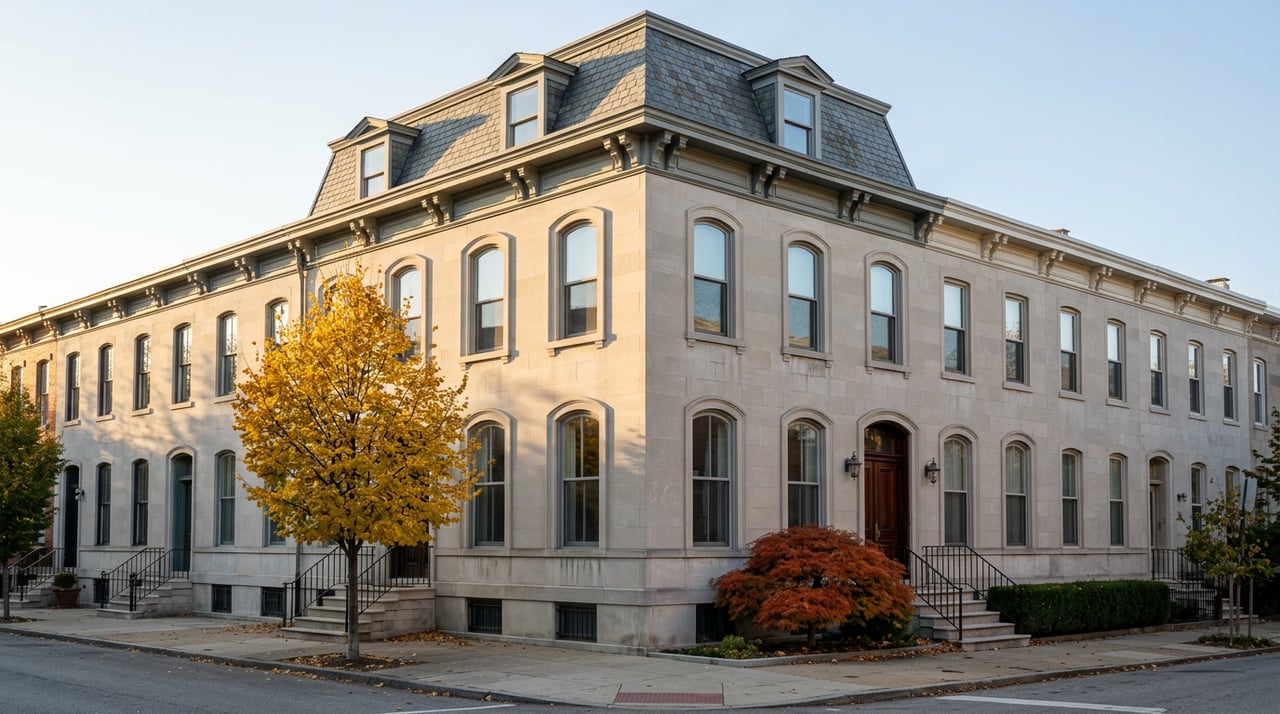
In May 2008, workers began tearing the top floors off a corner mansion at 100 Clark Street. The 1852 Greek Revival house, built for a merchant named Samuel Bell and later home to the Weir family behind the Montague Street flower shop that has run continuously since 1853, sat partially demolished for years. Neighbors watched it from the sidewalk, uncertain whether the rest would come down too.
This October, anyone with a fifty-dollar ticket can walk through all six floors.
That reversal, from condemned to communal, is the through-line of Brooklyn Heights' fall calendar, and it says something about how this neighborhood actually works that doesn't show up in a restaurant roundup or a listing description. The institutions that run Brooklyn Heights are not commercial. They are volunteer-staffed civic groups that have been doing this for over a century, and their events fill the calendar this September and October.
A House With a Second Act
One Monroe Place, as the mansion is now known, spent ten years under gut renovation before its mansard roof and Greek Revival details were restored close to original. The Brooklyn Heights Association, the country's oldest neighborhood civic association, secured it for the 2026 Designer Showhouse, its main fundraiser, held every two years since 2017. Seventeen designers and architects have redone every room and the rooftop terrace, according to the BHA's own announcement, turning nine bedrooms and seven baths into a walk-through catalog of how a landmarked house can be lived in now.
The Showhouse opens with a private party on September 30, then to the public from October 2 through November 1, Thursdays and Fridays 11 a.m. to 7 p.m., weekends 11 a.m. to 6 p.m. General tickets run $50, $40 for BHA members, with ten-packs at $450 for anyone planning repeat visits or bringing a group. Full details and tickets are on the Designer Showhouse's official site.
What makes this particular Showhouse different from earlier Showhouses is the sponsor list. Alongside design names like Farrow & Ball, Schumacher, and Kravet sits Kantha, a detail that means the team behind this post has a direct, on-record stake in whether this house draws a crowd. That is disclosed here because it should be, not because it changes the facts: the mansion nearly came down, and this fall it belongs to the public for the first time since 1950s subdivision turned it into rental apartments.
Six Fixed Points Across the Fall
Lay the fall calendar flat and the density becomes obvious. Nothing on this list is new to Brooklyn Heights. All of it is happening closer together than usual.
| Date | What | Where |
|---|---|---|
| Sept. 11 | 25th-anniversary Interfaith 9/11 memorial service | Promenade, Montague Street entrance |
| Sundays, starting Sept. 13 | Open Streets Montague, weekly street closure | Montague St., Clinton to Hicks |
| Sept. 19 | Repast Baroque, "Pigment: Prussian Blue" | McKinney Chapel, 121 Pierrepont St. |
| Sept. 18–20 | Heights Players, "Damn Yankees," closing weekend | John Bourne Theater, 26 Willow Place |
| Sept. 30 | Designer Showhouse Opening Night Party | One Monroe Place, 100 Clark St. |
| Oct. 2–Nov. 1 | Designer Showhouse, public hours | One Monroe Place |
The 9/11 service already happened this year, on its 25th anniversary, organized by the Brooklyn Heights Interfaith Clergy Association, a group of Christian, Jewish, and Muslim clergy who have held the same candlelight observance at the same Promenade entrance for a quarter century. It is not a tourist event. It is neighbors who lost neighbors, gathering at 7:15 p.m. because that is when it has always started.
The Heights Players, a community theater group performing out of the John Bourne Theater on Willow Place, closed out their run of Damn Yankees on September 18–20, directed by Marie Ingrisano Isner. Repast Baroque played McKinney Chapel on the 19th to open a concert series built around the accidental 1704 discovery of Prussian Blue pigment and its relationship to music. Neither of these draws a press list. Both have been doing this long enough that regulars just know the schedule.
The Street That Closes Anyway
Open Streets Montague is the most physical version of the same pattern. Each Sunday this fall, Montague Street between Clinton and Hicks shuts to traffic from 10 a.m. to 7 p.m., cars moved by 10, run jointly by the Montague Street BID, the Brooklyn Heights Association, and the city's Department of Transportation. This fall's season opener, a Back to School Party sponsored by Brooklyn Bridge Parents, already happened on September 13, its start time pushed from noon to 1 p.m. because of a weather forecast that week. Last year's fall run went Sundays through late October, and the BID has followed a similar weekly cadence for years.
What's worth noticing is who signs off on that kind of schedule change. Not a single business, not a landlord, but three co-sponsors coordinating a public street closure around a kids' event. That is the same governance structure behind the Showhouse and the 9/11 service: overlapping, volunteer-heavy civic groups that have run this neighborhood's calendar for generations and are still doing it, at the same time, this fall.
Atlantic Avenue Turns Over, But Stays Small
The one place where money moves visibly is the restaurant corridor on the western end of Atlantic Avenue, where Colonie closed last November after nearly fourteen years, citing expiring leases and rising costs. Its sister spots, Hildur in DUMBO and Pips on Atlantic, closed around the same window.
Into that space came Confidant, run by chefs Brendan Kelley and Daniel Grossman, who met working the kitchen at Roberta's back in 2017 and had their first full-service restaurant slot at Industry City before relocating to Columbia Place, just off Atlantic. The room keeps the old Colonie banquette and is furnished with family heirlooms from both chefs' grandparents. Their signature dish, a prawn pot pie, is Grossman's own reference to his time cooking at Gage and Tollner.
When Confidant noticed diners lingering well past 9 p.m., the chefs turned the adjoining former Pips space into Frenzie, a pizza and wine spot that opened in August at 129 Atlantic. A third project, Lou and Bev's, a bakery by day and pizza counter by night with pastry chef Mariah Neston, is opening next door to that. Around the corner, an empanada counter called Empanada City aimed to open at 107 Atlantic before Labor Day.
These changes are coming from local operators. It's the same handful of people building out adjacent storefronts one at a time, the way Brooklyn Heights tends to change according to residents who've watched it happen for more than a season or two. Even Ingas Bar, a longtime neighborhood favorite, is expanding outward, opening a sister spot in Boerum Hill with a bar to follow on Bond Street. The direction of travel is Brooklyn Heights exporting its own operators.
The same small-scale pattern shows up in the handful of construction projects making local development news this month: a four-story single-family house on Joralemon Street, a five-story building on State Street that preserves its landmarked street-level facade, a four-story multi-family conversion to a single mansion on Willow Place. Even the one larger project, a 14-story building replacing a two-story former drugstore at Court and Atlantic, is an outlier precisely because it's the only one on a list otherwise made up of townhouse-scale work.
What Actually Sets the Calendar
None of these threads needed each other to happen. The Interfaith Clergy Association doesn't coordinate with the Montague Street BID. The Heights Players don't answer to the Brooklyn Heights Association. Confidant's chefs aren't thinking about the Designer Showhouse when they plan a menu. But they land in the same stretch of the fall anyway, and that overlap is the actual story: Brooklyn Heights still runs on volunteer civic infrastructure that predates most of the businesses on Atlantic Avenue by decades, and a house that was half-demolished in 2008 is, for one month this fall, the most public room in the neighborhood.
If you already live here, that's simply the calendar. If you're weighing what a neighborhood like this actually offers beyond a subway stop and a school zone, it's worth sitting with the fact that the mansion everyone's walking through this October almost wasn't standing at all.
The Kantha Team is a proud supporter of the Brooklyn Heights Association's work preserving buildings like One Monroe Place. If you're weighing a move into Brooklyn Heights or Brownstone Brooklyn more broadly, schedule a consultation with our team to talk through what the neighborhood actually offers beyond its calendar.